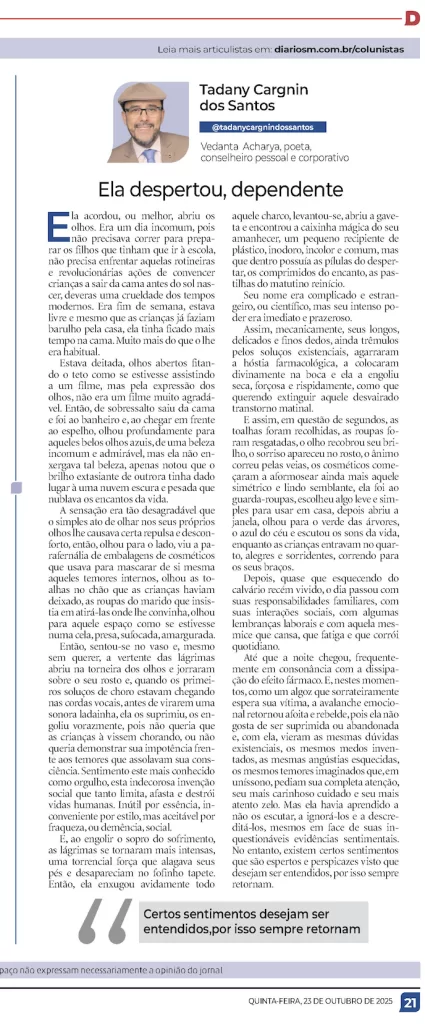
Tadany Um refúgio para a alma e um convite à consciência.


and, unwillingly, the fountain of tears opened from the faucet of her eyes, pouring down her face. When the first sobs began to reach her throat, before turning into an audible lament, she suppressed them, swallowed them fiercely, because she didn’t want the children to see her crying, or perhaps didn’t want to show her helplessness before the fears haunting her conscience.
She woke up, or rather, opened her eyes. It was an unusual day because she didn’t have to rush to get the children ready for school. She didn’t have to face that routine, yet revolutionary, tasks of convincing children to get out of bed before the sun rose, surely one of modern times’ cruelties. It was the weekend. She was free, and although the children were already making noise around the house, she stayed in bed longer, much longer than usual.
She lay there, eyes open, staring at the ceiling as if watching a movie, but judging by her expression, it wasn’t a pleasant one. Then, with a sudden impulse, she got up and went to the bathroom. Standing before the mirror, she looked deeply into those beautiful blue eyes of uncommon and admirable beauty. But she couldn’t see that beauty; she only noticed that the once radiant glow had given way to a heavy dark cloud that dimmed life’s charms.
The feeling was so unpleasant that merely looking into her own eyes filled her with disgust and discomfort. She looked away and saw the paraphernalia of cosmetic bottles she used to mask her inner fears, the towels on the floor left by the children, her husband’s clothes tossed wherever he pleased. She looked at that space as if it were a cell, trapped, suffocated, embittered.
Then she sat down on the toilet, and, unwillingly, the fountain of tears opened from the faucet of her eyes, pouring down her face. When the first sobs began to reach her throat, before turning into an audible lament, she suppressed them, swallowed them fiercely, because she didn’t want the children to see her crying, or perhaps didn’t want to show her helplessness before the fears haunting her conscience. That feeling is better known as pride, that indecent social invention that limits, separates, and destroys human lives. Useless by essence, inconvenient by style, yet accepted out of social weakness, or madness.
And as she swallowed the breath of suffering, the tears became more intense, a torrential force flooding her feet and disappearing into the soft rug. Then she hastily wiped away the puddle, stood up, opened the drawer, and found the little magic box of her mornings, a small, odorless, colorless, ordinary plastic container, yet holding inside it the pills of awakening, the tablets of enchantment, the lozenges of a morning rebirth. Its name was complicated—foreign, scientific—but its power was immediate and pleasurable.
Thus, mechanically, her long, delicate, slender fingers—still trembling from existential sobs—grasped the pharmaceutical host, placed it reverently in her mouth, and swallowed it dry, forcefully, harshly, as if trying to extinguish the deranged turmoil of that morning disorder.
And so, in a matter of seconds, the towels were picked up, the clothes restored, her eyes regained their sparkle, a smile appeared on her face, energy ran through her veins, the cosmetics once again beautified that symmetrical and lovely face. She went to the wardrobe, chose something light and simple to wear at home, then opened the window, looked at the green of the trees, the blue of the sky, and listened to the sounds of life—while her children ran joyfully into the room, smiling, and jumped into her arms.
Later, almost forgetting the ordeal she had just lived, the day passed—filled with family duties, social interactions, work-related memories, and that sameness that tires, fatigues, and corrodes the everyday.
Until night arrived—often coinciding with the fading of the drug’s effect. And in those moments, like an executioner silently awaiting his victim, the emotional avalanche returned—eager and rebellious—for it does not like being suppressed or abandoned. Along with it came the same existential doubts, the same invented fears, the same forgotten sorrows, the same imagined anxieties—all in unison, demanding her full attention, her tender care, her devoted concern. But she had learned not to listen—to ignore them, to discredit them—even in the face of their undeniable emotional evidence. Yet, some feelings are clever and persistent, for they wish to be understood—and therefore, they always return.
But regardless of them, life must go on, and she needed her nightly rest. In that inner battle between conversing with her awakened demons or surrendering to the lightness of sleep, she lay in bed, noticing that everyone else was asleep while her eyes stared upward, fixed on the ceiling’s darkness. Her heart beat intensely, for existential musings seem to come alive at night and love a bed—for when she lies down, they awaken, and upon awakening, they don’t let her sleep.
And there she remained—breath agitated, eyes unmoving, feelings stunned, time passing—steady and slow, like the sands of an hourglass.
But sleep is necessary. So, with another jolt, she rose, went to the bathroom again, saw the towels and clothes scattered across the floor, and sighed at the messy repetition of life. Ignoring the chaos, she opened the drawer and, next to the magical morning box, found the coveted nightly case—the balm for the wounds of her consciousness. She opened it eagerly, anxiously, grabbed the first pill her fingers touched, threw it into her mouth while gazing into the mirror, and within seconds, saw those beautiful blue eyes turn gray—lifeless, dull, flat.
Then she dragged herself back to the bed, threw herself onto it, and fell asleep—a deep, numbing, induced sleep—without dazzling dreams, burning desires, or grand fantasies.
And thus life goes on—a routine physically chemical, spiritually anemic, structurally dysfunctional— yet functioning through unnatural intakes, surviving on pharmaceutical cravings.
And like countless things that make little sense, it keeps going— with its arrhythmic rhythm, its erratic cadence, its unintelligible tempo — step by step, living life in pieces, in daily exhaustion, in existential misalignment.
By Acharya Tadany Cargnin dos Santos.
Published in Diário de Santa Maria, October 23, 2025.
Translate into English, by ChatGPT.
https://unsplash.com/photos/a-blurry-image-of-a-button-on-a-wall-aEwgvCxW674