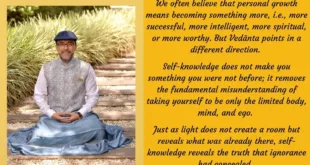
Tomorrow, as we celebrate Guru pūrṇimā, it is a beautiful time to reflect on what the “Guru” truly represents in our lives. In our Vedānta tradition, a Guru is not merely an external teacher, the very word itself reveals its purpose: Gu means the darkness of ignorance, and Ru means the remover. So, the Guru is the light that dispels avidyā …
Read More »Tag Archives: liberation
Bhagavad Gītā, Chapter 4, Class 189
Bhagavad Gītā – Chapter 4, by Acharya Tadany Summary – Class 189Date: July 23, 2026 In this class, Acharya Tadany continued the teaching on yajña (spiritual disciplines), emphasizing the distinction between action-based and knowledge-based practices. Q&A Before Class: The Nature of the Subtle Body Dipti asked whether the subtle body (sūkṣma śarīram) remains constant or changes like the physical body. …
Read More »Bhagavad Gītā, Chapter 2, Class 45
Bhagavad Gītā – Chapter 2, Acharya Tadany Summary – Class 45Date: June 5, 2025 In this class, Acharya Tadany focused on one of the most practical and liberating teachings of the Bhagavad Gītā: the wisdom of accepting choiceless situations in life. Understanding Choiceless Situations Acharya Tadany explained that the majority of life circumstances are beyond our control: The past (already …
Read More »Bhagavad Gītā, Chapter 4, Class 182
Bhagavad Gītā – Chapter 4, Acharya Tadany Summary – Class 182Date: June 6, 2026 In this class, Acharya Tadany clarified important questions about deep sleep and the witness consciousness, then presented Krishna’s teaching on the twelve forms of yajña (spiritual disciplines). Questions Before Class: Deep Sleep and the Witness Acharya Tadany explained the three states of experience: Jagrat (Waking): Engagement …
Read More »Bhagavad Gītā, Chapter 4, Class 178
Summary to Share with Students — Bhagavad Gītā Chapter 4, Class 178By Acharya TadanyApril 23, 2026In this deeply illuminating class, Acharya Tadany unfolded one of the Gītā’s most transformative teachings: liberation does not depend on abandoning life, but on understanding life correctly.A central distinction was made between sannyāsa and vairāgya. External renunciation may involve leaving worldly roles, but inner detachment …
Read More »Bhagavad Gītā, Chapter 4, Class 175
Bhagavad Gītā Chapter 4 – Class 175 Summary The Thermometer vs. Thermostat: Wisdom in Daily Life Acharya Tadany | April 4, 2026 In this illuminating session on Jñāna Karma Sannyāsa Yoga, Acharya Tadany used a powerful and practical metaphor to distinguish the inner state of a jñānī (wise person) from that of an ajñānī (unwise person). Core Teaching: Thermometer vs. …
Read More »Bhagavad Gītā, Chapter 6, Class 208
In this deeply integrative and practically transformative class on Dhyāna Yoga, Acharya Tadany presented samādhi as having a dual nature: (1) a profound state of mental tranquility achieved through deliberate spiritual practice — characterized by conscious withdrawal from worldly roles and identities (parent, professional, friend), detachment from external positions and titles, and creation of inner space free from constant demands, …
Read More »Stop Climbing. Start Knowing.
Acharya TadanyMorning MeditationPune, 02 Nov 2025. Yet the Gītā whispers something profoundly radical, Stop the imaginary climbing, and Start knowing your true nature because the sacred was never waiting at the end of time The Bhagavad Gita is not a ladder placed between earth and heaven, inviting you to climb toward some distant divinity. The Gita is a luminous, powerful …
Read More »Bhagavad Gītā, Chapter 2, Class 31
In this foundational and profoundly liberating class, Acharya Tadany identified self-ignorance (ātmā ajñāna) — not knowing one’s true nature as pure consciousness (ātmā) — as the root cause of all human suffering, confusion, grief, and problems, emphasizing that the Bhagavad Gītā’s central, unifying theme is self-knowledge (ātmā vidyā), a direct revelation rather than mystical tales. Acharya Tadany explained that supporting …
Read More »Bhagavad Gītā, Chapter 2, Class 30
n this profoundly empathetic and existentially rich class, Acharya Tadany positioned Arjuna as the universal archetype of humanity — every person who, despite intelligence, skill, and worldly achievements, eventually faces deep inner suffering, confusion, and despair that no material success (wealth, power, fame) or even elevated spiritual positions (such as becoming Indra, king of heaven) can resolve, because these are …
Read More »
Tadany Um refúgio para a alma e um convite à consciência.