

 Tadany Um refúgio para a alma e um convite à consciência.
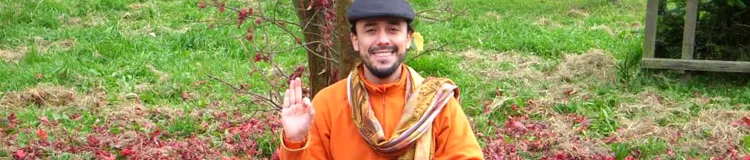
By Acharya Tadany
Published in Diário de Santa Maria, April 27, 2026

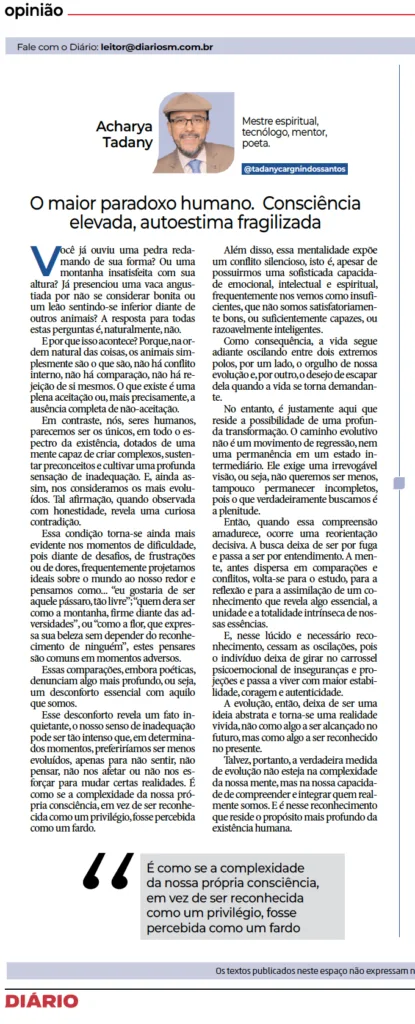
Have you ever heard a stone complaining about its shape? Or a mountain dissatisfied with its height? Have you ever seen a cow distressed for not considering itself beautiful, or a lion feeling inferior to other animals? The answer to all these questions is, naturally, no.
And why is that? Because, in the natural order of things, animals simply are what they are. There is no inner conflict, no comparison, no rejection of themselves. What exists is a complete acceptance or, more precisely, the total absence of non-acceptance.
In contrast, we human beings seem to be the only ones, across the entire spectrum of existence, endowed with a mind capable of creating complexes, sustaining prejudices, and cultivating a deep sense of inadequacy. And yet, we consider ourselves the most evolved, and such a claim, when observed honestly, reveals a curious contradiction.
This condition becomes even more evident in moments of difficulty. Faced with challenges, frustrations, or pain, we often project ideals onto the world around us and think things like: “I wish I were that bird, so free”; “If only I were like the mountain, steady in the face of adversity”; or “like the flower, expressing its beauty without depending on anyone’s recognition.” These reflections are common in times of hardship.
Such comparisons, though poetic, reveal something deeper, i.e., a fundamental discomfort with what we are.
This discomfort exposes an unsettling fact: our sense of inadequacy can become so intense that, at times, we would prefer to be less evolved, just so we wouldn’t feel, think, be affected, or have to strive to change certain realities. It is as if the very complexity of our consciousness, instead of being recognized as a privilege, is experienced as a burden.
Moreover, this mindset reveals a silent conflict: despite possessing a refined emotional, intellectual, and spiritual capacity, we often see ourselves as insufficient, as not good enough, not capable enough, or not intelligent enough.
As a result, life unfolds oscillating between two extremes: on one side, pride in our evolution; on the other, the desire to escape from it when life becomes demanding.
Yet, it is precisely here that the possibility of profound transformation resides. The path of evolution is not a movement of regression, nor a stagnation in an intermediate state. It requires an irrevocable vision: we do not want to be less, nor do we wish to remain incomplete. What we truly seek is fullness.
When this understanding matures, a decisive reorientation takes place. The search is no longer for escape, but for understanding. The mind, once scattered in comparisons and conflicts, turns toward study, reflection, and the assimilation of a knowledge that reveals something essential, the intrinsic unity and wholeness of our nature.
And in this lucid and necessary recognition, the oscillations cease. The individual no longer spins in the psycho-emotional carousel of insecurities and projections, but begins to live with greater stability, courage, and authenticity.
Evolution then ceases to be an abstract idea and becomes a lived reality, not something to be achieved in the future, but something to be recognized in the present.
Perhaps, therefore, the true measure of evolution lies not in the complexity of our mind, but in our capacity to understand and integrate who we truly are. And it is in this recognition that the deepest purpose of human existence resides.
Acharya Tadany
Photo by Bekah Allmark on Unsplash




Such a brilliant article. Thank you for sharing these thoughts, dear teacher! 🙏💕
Ignorance of the real self is what is required to be dealt with.