Tadany Um refúgio para a alma e um convite à consciência.

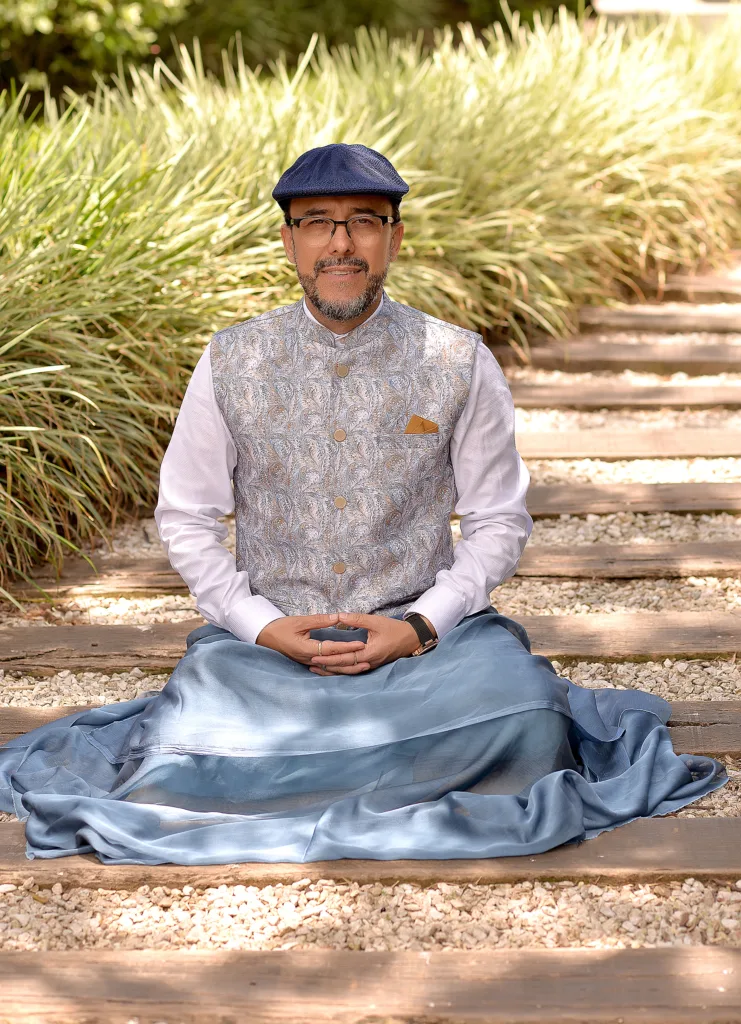
॥ तत्त्व बोध ॥ … Tattva Bodha … By Acharya Tadany
AI Summary – Class 55, Aug 3, 2025
Summary
Jīva-Īśvara Aikyam — The Core Teaching of the Upaniṣads
Acharya Tadany introduced the fourth topic of Tattva Bodha, which represents the essence of all Upaniṣadic teaching: Jīva-Īśvara Aikyam — the oneness between the individual (Jīva) and God (Īśvara), also called Jīvātmā-Paramātmā Aikyam. This teaching belongs to the Jñānakāṇḍa (knowledge portion) of the Vedas.
The Upaniṣads condense this vision into statements called Mahāvākyas (Great Statements), which are the fundamental equations of existence. Among these, the most frequently quoted is:
Tat Tvam Asi (तत् त्वम् असि) — “That Thou Art”
- Tat (That) = God, Īśvara
- Tvam (Thou) = You, the individual, the student, the Jīva
- Asi (Art) = The connecting verb, indicating identity
In simplified terms: You are God. This is what the Guru teaches through Tat Tvam Asi, and the student’s acknowledgment and assimilation of this teaching is expressed as Aham Brahmāsmi (I am Brahman).
The Necessity of This Knowledge
Acharya Tadany emphasized that this knowledge is not optional but compulsory for every spiritual seeker. Why? Because as long as we don’t have this knowledge, we continue to harbor misconceptions about ourselves and the world. The fundamental misconception is the notion of separateness — that “I am different from God” or “God is different from me.”
This misconception of difference is called Bheda. It is the root cause of all saṃsāra — the cycle of suffering that includes fear, delusion, confusion, jealousy, anger, dissatisfaction, judgment, and self-non-acceptance. A spiritual seeker is precisely one who wants to come out of this endless merry-go-round of suffering.
When to Drop the Notion of Difference
Acharya Tadany clarified an important point: during the preparatory stages of spiritual practice — namely Karma Yoga and Upāsanā Yoga — we are allowed to maintain the notion of difference. At this stage, we can continue seeing ourselves as the worshiper and God as the worshiped, ourselves as the meditator and God as the object of meditation.
However, once the mind becomes prepared — once Sādhanā Catuṣṭaya Sampannam (the fourfold qualifications) are attained — we must be ready to drop this misconception of difference and recognize the essential oneness.
To illustrate this, Acharya Tadany used the analogy of pole vaulting: The athlete runs with a long pole and uses it to reach great heights (over six meters in world records — twice the height of a typical ceiling). But once the pole has helped the athlete reach a certain height, the athlete must push themselves even higher and let go of the pole to clear the bar.
Similarly, the notion of difference (Bheda) is like the pole — it helps us during Karma Yoga and Upāsanā Yoga to reach a certain spiritual height. But to reach the level of Upaniṣadic understanding, we must make an additional effort: we must drop the pole and recognize that the essential nature of the individual and God is one and the same.
Two Perspectives: Vācārtha and Lakṣyārtha
To resolve the apparent contradiction — “How can I and God ever be the same when we are so obviously different?” — Acharya Tadany introduced a crucial distinction between two levels of meaning:
- Vācārtha (वाचार्थ) = Direct meaning, superficial perspective, empirical perspective
- Lakṣyārtha (लक्ष्यार्थ) = Implied meaning, contextual meaning, essential perspective
He illustrated this with the wave and ocean analogy:
If someone asks: “Are the wave and the ocean identical or different?”
We should counter-question: “Are you asking from the superficial perspective or from the essential nature perspective?”
- From the superficial perspective (Vācārtha): The wave is NOT the ocean, and the ocean is NOT the wave. They are clearly different.
- From the essential perspective (Lakṣyārtha): There is no wave other than water, and there is no ocean other than water. Both wave and ocean are nothing but water. From this angle, wave IS ocean and ocean IS wave.
When you remove water, there is neither wave nor ocean. So when you shift your attention from the wave-vision and ocean-vision (micro and macro) to the water-vision, you can clearly state: “Wave is ocean, and ocean is wave” — because both are nothing but water.
Applying the Analogy to Jīva and Īśvara
Similarly, between Jīva (the individual) and Īśvara (God), we can look from two different angles:
From the Vācārtha perspective (superficial, incidental):
Both Jīva and Īśvara are associated with:
- Reflecting Medium (RM) — the body/mind apparatus
- Reflected Consciousness (RC) — the consciousness reflected in that medium
From this standpoint, they are unquestionably different:
- Jīva’s body is the Sthūla Śarīra (gross body) and Sūkṣma Śarīra (subtle body) — limited in space and time, like a tiny dot.
- Īśvara’s body is the entire universe — vast, expanding, endless.
- The Jīva’s reflected consciousness is like a grain of sand on an endless beach.
- Īśvara’s reflected consciousness is like that enormous, endless beach itself.
From this perspective of RM and RC, the distinction is irrevocable — there is no doubt in anyone’s mind that they are different.
From the Lakṣyārtha perspective (essential, contextual):
Now shift your attention to the Original Consciousness — to Ātman. Remember the definition from the beginning of Tattva Bodha:
Sthūla-sūkṣma-śarīrābhyām vilakṣaṇaḥ
Pañcakośa-vilakṣaṇaḥ
Avasthā-traya-sākṣī
Sat-cit-ānanda-svarūpaḥ
(Different from the gross and subtle bodies, different from the five sheaths, witness of the three states, whose nature is Existence-Consciousness-Fullness)
This is the Lakṣyārtha — the implied, contextual meaning. When you shift from Vācārtha (RM and RC) to Lakṣyārtha (Original Consciousness, Ātman), then:
Jīva IS Īśvara, and Īśvara IS Jīva
Both have the same essential nature: Śuddha Caitanya (Pure Consciousness), which is Sat-Cit-Ānanda.
The Guru teaches this as Tat Tvam Asi (You are That). The student acknowledges and assimilates it as Aham Brahmāsmi (I am Brahman).
Addressing the Student’s Doubt
At this point, the student naturally wonders (nanu — “but how?”):
“How can Jīva and Īśvara ever be one and the same?”
“How can I and God be identical? Isn’t this a wrong statement?”
“We are diagonally opposite, unquestionably different!”
- Jīva is the worshiper — I offer prayers and rituals.
- Īśvara is the worshiped — God receives my prayers and offerings.
- I am the meditator; Īśvara is the object of meditation.
- One is the master; the other is the servant.
“The entire universe — including myself, my family, friends, everything known and unknown — is included in Īśvara. I am limited in height, weight, intellect, emotions. How can we possibly be the same? Isn’t it even sacrilege to say so?”
The Guru responds calmly: “Relax. This is a valid and common question. But once you understand it, you will happily claim that fact.”
Closing the Communication Gap
Acharya Tadany explained that whenever there is a communication gap between Guru and student — when the contextual meaning (Lakṣyārtha) is not yet clear — the Mahāvākya will never truly enter the student’s mind. The doubt (nanu) demonstrates this gap.
However, when the vision becomes clear and there is no gap between what is taught and what is assimilated, all contradictions vanish.
Understanding “You” and “I” Correctly
The key is to understand the words correctly:
- Superficial meaning of “You” (Vācārtha): Sthūla-sūkṣma-śarīrābhimānī — identified with the gross and subtle bodies, the Reflecting Medium (RM) and Reflected Consciousness (RC).
- Essential meaning of “You” (Lakṣyārtha): Upādhi-vinirmuktam (free from limiting adjuncts), samādhi-daśā-sampannam (established in the state of understanding), śuddhaṃ caitanyam (pure consciousness).
Throughout the entire spiritual journey, when the Guru says “you” (Tvam), the student must understand it as “I” (Aham) — but not the body-I, not the mind-I, not the senses-I. Rather, I the
Original Consciousness.
Acharya Tadany shared an example: A student at a Gurukulam wrote on his study table as a reminder: “Guruji is talking about myself.” During every class, when the Guru speaks about Original Consciousness, the student remembers: “This is not something distant or alien — the teacher is talking about my true nature.”
This understanding is called Samādhi-darśana — a state of understanding where the meaning of “I” is Śuddhaṃ Caitanyam (Pure Consciousness), which is completely different from Reflected Consciousness.
Reflected vs. Original Consciousness
Acharya Tadany used the mirror analogy to clarify:
- Reflected Consciousness (RC) is always distorted. Why? Because the reflection depends on the medium. If the mirror is concave, you get one type of distorted reflection. If it’s convex, you get another. The medium generates distorted images.
- Original Consciousness is never distorted. It is Śuddham (pure, undistorted).
So, when the Guru says Tvam (You), the student understands: Śuddhaṃ caitanyam aham — “I am that original, undistorted consciousness.” This is Tvam-pada-lakṣyārtha — the implied, contextual meaning of the word “You.”
Likewise, Aham-pada-lakṣyārtha (the implied meaning of “I”) is this same pure, original consciousness.
The class concluded with Acharya Tadany noting that this topic would continue in the next session, exploring further the contextual meanings and deepening the student’s assimilation of this profound teaching.
Acharya Tadany