Tadany Um refúgio para a alma e um convite à consciência.
By Acharya Tadany.
Published in the Diário de Santa Maria, September 10, 2026.
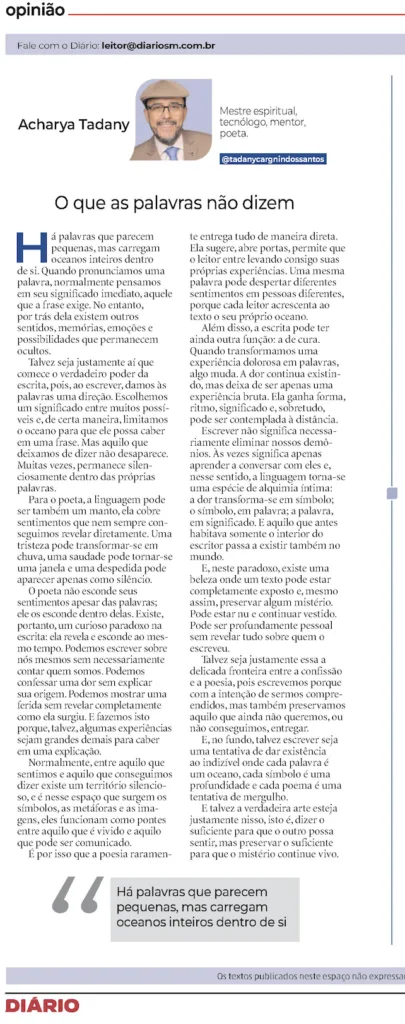
For the poet, language can also be a mantle, it covers feelings we cannot always reveal directly. A sadness can turn into rain, a longing can become a window and a farewell can appear only as silence.
There are words that seem small, yet carry entire oceans within themselves. When we pronounce a word, we normally think of its immediate meaning, the one the sentence demands. However, behind it there exist other senses, memories, emotions and possibilities that remain hidden.
Perhaps that is precisely where the true power of writing begins, for, in writing, we give words a direction. We choose one meaning among many possible ones and, in a certain way, we limit the ocean so that it may fit into a sentence. But what we leave unsaid does not disappear. Often, it remains silently within the words themselves.
For the poet, language can also be a mantle, it covers feelings we cannot always reveal directly. A sadness can turn into rain, a longing can become a window and a farewell can appear only as silence.
The poet does not hide his feelings despite the words; he hides them within them. There exists, therefore, a curious paradox in writing: it reveals and hides at the same time. We can write about ourselves without necessarily telling who we are. We can confess a pain without explaining its origin. We can show a wound without fully revealing how it came to be. And we do this because, perhaps, some experiences are too large to fit into an explanation.
Normally, between what we feel and what we manage to say there exists a silent territory, and it is in this space that symbols, metaphors and images arise, they function as bridges between what is lived and what can be communicated.
That is why poetry rarely delivers everything in a direct manner. It suggests, opens doors, allows the reader to enter carrying their own experiences. The same word can awaken different feelings in different people, because each reader adds to the text their own ocean.
Moreover, writing can have yet another function: that of healing. When we transform a painful experience into words, something changes. The pain continues to exist, but it ceases to be merely a raw experience. It gains form, rhythm, meaning and, above all, it can be contemplated from a distance.
To write does not necessarily mean to eliminate our demons. At times it means only learning to converse with them and, in this sense, language becomes a kind of intimate alchemy: pain transforms into symbol; the symbol, into word; the word, into meaning. And what once dwelt only in the writer’s interior now comes to exist in the world as well.
And, in this paradox, there exists a beauty where a text can be completely exposed and, even so, preserve some mystery. It can be naked and remain clothed. It can be profoundly personal without revealing everything about who wrote it.
Perhaps that is precisely the delicate frontier between confession and poetry, for we write with the intention of being understood, but we also preserve what we do not yet want, or cannot, deliver.
And, deep down, perhaps to write is an attempt to give existence to the unsayable where each word is an ocean, each symbol is a depth and each poem is an attempt at diving.
Poet Tadany
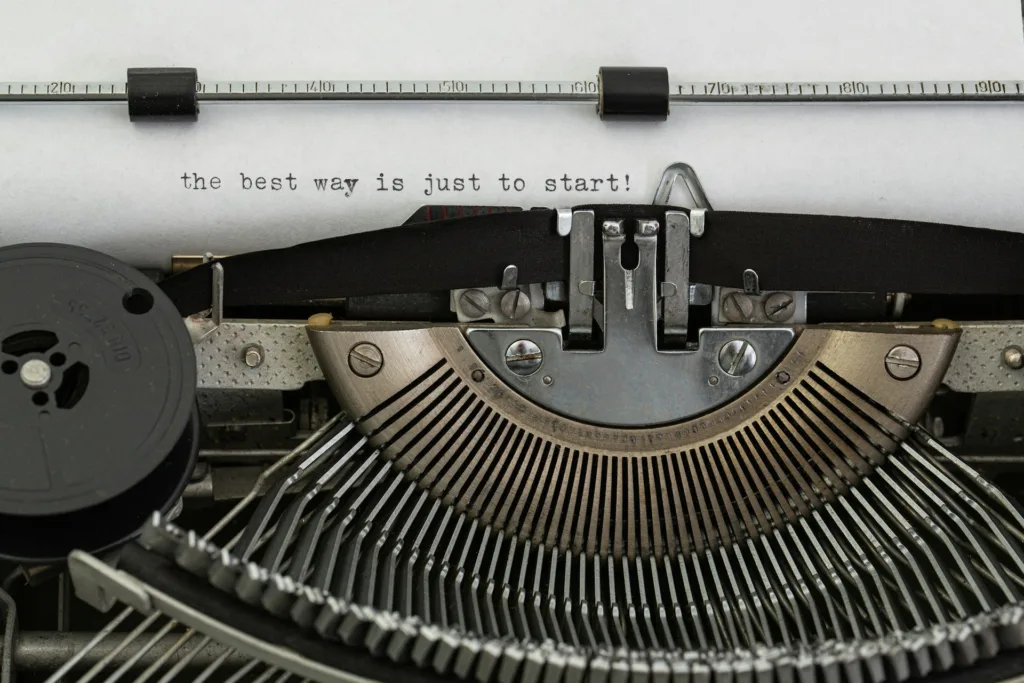
Photo by Wilhelm Gunkel on Unsplash
Join Acharya Tadany’s WhatsApp community to receive thoughts, poems, reflections on spirituality, and artistic inspirations directly in a secure and private space:
Come join me. 👉 https://chat.whatsapp.com/H9LvWtle5n6KdsIIMxYI8D