Tadany Um refúgio para a alma e um convite à consciência.

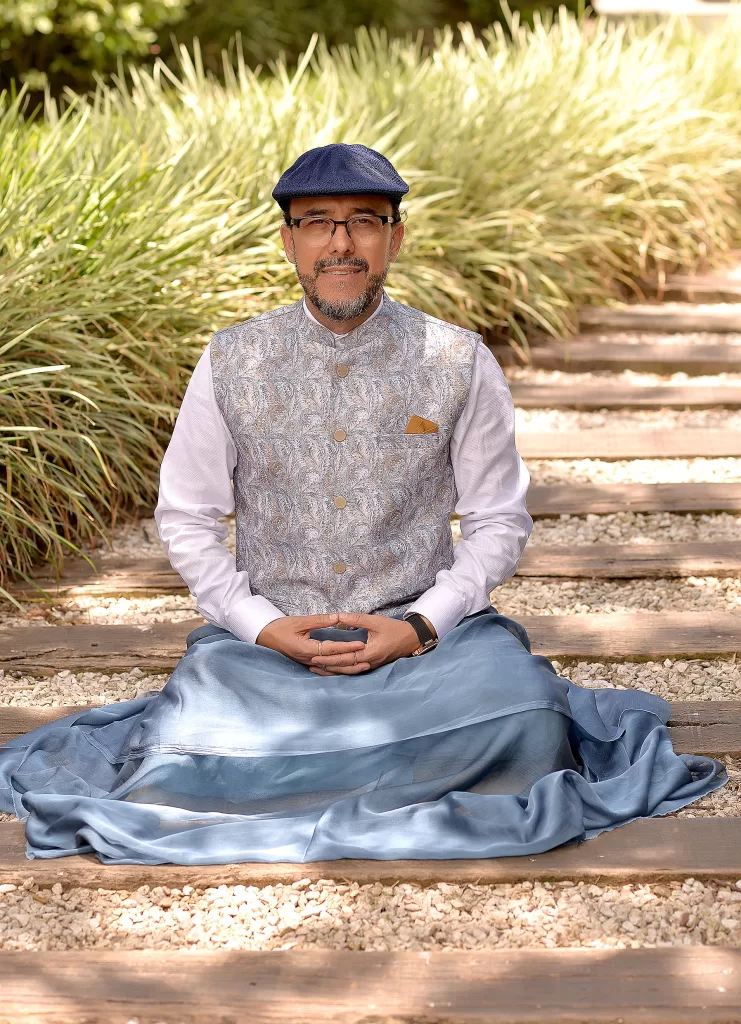
॥ विवेकचूडामणि ॥ … Vivekacūḍāmaṇi … by Acharya Tadany
Class 139, Oct 7, 2026.
Summary
Acharya Tadany began the formal teaching by chanting the opening prayers and then introduced verse 135 from Vivekacūḍāmaṇi.
He noted a small correction needed in the transliteration: “Avāstāsu” was missing the “Ukāra” in the third line.
The verse reads:
Prakṛti vikṛti bhinnāḥ Śuddhābodhasvarūpaḥ
Sadāsadam aśeṣaṁ bhāsayan nirviśeṣaḥ
Vilasati paramātmā jagrādāv avāstāsu
Aham aham iti sākṣāt sākṣi-rūpeṇa buddhau
The Sākṣi (Witness) Nature of Ātmā
Acharya Tadany explained that this verse highlights the sākṣi (witness) nature of Ātmā, which is the most important characteristic of consciousness because every experience we have—both external and internal—proves the presence of consciousness as the witness or observer.
He drew an analogy: just as every picture proves the existence of a camera even though the camera never appears in the picture itself, every experience proves the existence of consciousness as the witness.
This witness consciousness illuminates all experiences: sensory perceptions of the external world, internal thoughts and emotions, and even the awareness of what we know and don’t know. The very fact that we can speak about anything—happiness, objects, the world—demonstrates that we are the witness of all these phenomena.
Prakṛti and Vikṛti: Cause and Effect in Matter
Acharya Tadany analyzed the first line of the verse: Prakṛti vikṛti bhinnāḥ (distinct from Prakṛti and Vikṛti).
He explained that Prakṛti means “cause” (kāraṇam) and refers to the material cause, specifically the root material cause of the universe, which is Māyā. Prakṛti can be understood as the basic matter principle or fundamental energy—the most fundamental form of matter.
Vikṛti means “effect” (kāryam) and refers to all modifications and evolutions of Prakṛti. The evolution process proceeds from energy condensing into subatomic particles, which form atoms, then molecules, then cells, then organs, then the complete body. This entire process of grossification—from the subtle elements to the gross elements and elementals—constitutes Vikṛti.
Both Prakṛti and Vikṛti represent stages or conditions of matter and are savikāra (subject to modification).
Paramātmā: Distinct from Matter
The verse declares that Paramātmā (consciousness) is bhinnāḥ (distinct) from both Prakṛti and Vikṛti. Consciousness is neither the basic causal matter nor the evolved universe and everything within it. This is a crucial philosophical point: the Śāstra does not view consciousness as a product born out of matter or as something that evolved from biological processes. If consciousness were a product of the brain or matter, it would fall under Vikṛti (effect), but the teaching explicitly states that consciousness is distinct from both cause and effect.
Since consciousness is not matter, it is not subject to any laws of matter or energy. No scientific law applies to consciousness—it is scientific law atītaḥ (beyond scientific laws), deśa atītaḥ (beyond space), and kāla atītaḥ (beyond time).
Acharya Tadany noted that some modern scientists are beginning to acknowledge that consciousness cannot be studied under existing scientific theories and principles, and it remains a mystery in the field of science.
Individual Application: Three Śarīras
The same analysis applies at the individual level. From the individual (jīva) standpoint, Prakṛti corresponds to Kāraṇa Śarīram (causal body), while Vikṛti corresponds to Sūkṣma and Sthūla Śarīrams (subtle and gross bodies). Both are savikāra (subject to change).
Consciousness (Ātmā) is distinct from all three bodies and is nirvikāra (changeless), neither the cause nor the effect of the bodies.
Śuddhabodhasvarūpa: Pure Consciousness
The verse describes Paramātmā as śuddhabodhasvarūpaḥ—of the nature of pure consciousness. Because consciousness is not matter or energy, it is not subject to modification or change. It is the unchanging, eternal principle that illuminates all modifications of matter.
Sat and Asat: Gross and Subtle Matter
Acharya Tadany provided an important clarification about the second line: Sadāsadam aśeṣaṁ bhāsayan (illuminating all sat and asat without exception).
In this specific context, sat means gross matter (mūrta prapañca), and asat means subtle matter (amūrta prapañca). This usage differs from other contexts where “sat” refers to pure consciousness (as in Sat-Cit-Ānanda).
This definition comes from the Bṛhadāraṇyaka Upaniṣad section called Mūrta Amūrta Brahmaṇam, which describes two modes of Brahman: mūrtam (with form, concrete, mortal, limited, defined) and amūrtam (formless, immortal, expansive, undefined).
At the macro level, mūrta prapañca is matter and amūrta prapañca is energy.
At the individual level, mūrta refers to sthūla śarīram (gross body) and amūrta refers to sūkṣma and kāraṇa śarīrams (subtle and causal bodies).
Consciousness illuminates (bhāsayan) all these forms of matter—from the grossest to the subtlest—completely (aśeṣam, without exception).
However, this illumination is not a willful action; it simply means that in the presence of consciousness, everything is known and illuminated.
Nirviśeṣaḥ: Without Attributes
The verse states that Paramātmā is nirviśeṣaḥ—absolutely without features, qualities, or attributes (synonymous with nirguṇaḥ). Acharya Tadany referenced a long section from the Bṛhadāraṇyaka Upaniṣad that systematically negates all superimpositions: it is not gross (asthūlam), not atomic (anaṇu), not short (ahrasvam), not long (adīrgham), without smell (agandham), without taste (arasam), without physical eyes (acakṣuḥ), without ears (aśrotram), without voice (avāk), without mind (amanaḥ), without light (atejah), dimensionless (aprāṇam), without inside (anantaram), and without outside (abāhyam).
This neti neti (not this, not this) approach systematically removes all common features we experience in the world, demonstrating that consciousness has no attributes that belong to matter. Each negation addresses a potential superimposition, clarifying that Ātmā transcends all material characteristics.
Vilasati: Self-Evident and Self-Proving
The word vilasati means “it shines” or “it is self-evident.” Acharya Tadany addressed a potential objection: if consciousness has no features, faculties, or attributes, how do we know it exists? The answer is that consciousness is the one thing that proves everything else—the prover of everything does not require proof. If the prover required another proof, that proof would require yet another proof, leading to infinite regress (anavasthā).
Therefore, consciousness must be self-proving (svataḥ siddhaḥ, svayaṁ prakāśaḥ). It shines by itself and illuminates everything else without requiring any external validation. Acharya Tadany referenced the Kaṭha Upaniṣad mantra often chanted during dīparādhanā:
Na tatra sūryo bhāti na candratārakam
Nemā vidyuto bhānti kuto’yam agniḥ
Tam eva bhāntam anubhāti sarvam
Tasya bhāsā sarvam idaṁ vibhāti
This mantra, recited during lamp offerings, is a declaration of our ignorance—we attempt to illuminate the Lord with a small piece of camphor, while He is the consciousness by which everything, including the camphor, the flame, the priest, and the entire universe, is illuminated. The doubter (the one seeking proof) can never be doubted, because the very act of doubting proves the existence of consciousness.
Illuminating the Three States of Experience
The verse states: jagrādāv avāstāsu (in all states beginning with the waking state). Consciousness illuminates all three states—jāgrat (waking), svapna (dream), and suṣupti (deep sleep)—even as the perspective of time changes across these states.
Acharya Tadany explained that each state operates in a different time series. In the waking state, events occur according to one timeline. In the dream state, although a dream may last only 90 seconds in the waker’s perception, years may pass within the dream itself—grandchildren may be born, marriages may occur, and various events may unfold across different locations. The dreamer and the waker experience completely different time series.
In deep sleep (suṣupti), time is not experienced at all. Yet consciousness illuminates the arrival and departure of each state: the arrival of the waking state’s time series, its departure, the arrival of the dream state’s time series, its departure, and even the timelessness of deep sleep. Since consciousness illuminates all time series, it cannot be within any time series. The same logic applies to space—consciousness illuminates both waking space and dream space and therefore cannot be confined within either.
Aham Aham Iti Sākṣāt: The “I” Consciousness
The verse continues: aham aham iti sākṣāt (as “I, I” directly/immediately). Consciousness is available directly to each person as the very subject—the fundamental “I.” This does not require any proof because the ultimate subject is not subject to perception and therefore needs no validation.
Acharya Tadany illustrated this with an example: If asked whether a particular student has come to class, one must look around (using pratyakṣa pramāṇa, direct perception) or ask someone else (using anumāna, inference). External objects require instruments of knowledge—perception, inference, microscopes, telescopes—to validate their existence.
But if asked “Have you come to class today?”, no one needs to think, plan, perceive, or infer. No instrument is needed. One does not need validation from anyone else. Why? Because the self is that which enlivens the observer in the first place. You may doubt what you see, hear, remember, or think, but you can never doubt your own existence. The one thing that requires no proof is “I”—the consciousness principle.
This “I” remains constant throughout life: as a child—”I”; as a teenager—”I”; as a young adult—”I”; as an elderly person—”I”. Everything else changes, both internally and externally, but the consciousness principle remains unchanging.
Sākṣāt: Immediately, Without Medium
The word sākṣāt means “immediately” or “without requiring any medium.” Consciousness does not need the eyes, ears, or any sense organ to validate its own existence. One can close one’s eyes and still be aware of existence. It does not require pratyakṣa pramāṇa (direct perception through the senses) or anumāna (inference) or thoughts as intermediaries.
Even when thoughts are absent, consciousness is still evident as the illuminator of the thoughtless state itself. If consciousness required a medium, then when the medium is absent, consciousness would not be evident. But consciousness is evident even in the absence of all media—in thoughtlessness, senselessness, worldlessness. We can speak of thoughtlessness, timelessness, and spacelessness only because of consciousness. Therefore, consciousness shines immediately (sākṣāt), without any intermediary.
Sākṣi-Rūpeṇa Buddhau: Witness of the Mind
The verse concludes: sākṣi-rūpeṇa buddhau (as the witness in the intellect/mind). Consciousness shines as the illuminator of buddhi (the mind). Acharya Tadany emphasized an important point: the mind itself is distinct from the brain. The brain is tangible, has weight, and periHes at death—it is sthūla (gross). The mind is intangible and does not perish at death—it is sūkṣma (subtle).
Science has not yet proven the existence of the subtle body (sūkṣma śarīram); as far as current science is concerned, the mind is simply the physical brain. But in the Śāstra, the mind and brain are distinct. Science still has a long way to travel: first to accept sūkṣma śarīram, then kāraṇa śarīram, and finally to come to Vedānta to understand Ātmā. Meanwhile, students rely on the Śāstra, which declares that consciousness shines self-evidently as the witness of the mind.
Question and Answer: Clarifying Prakṛti, Vikṛti, Mūrta, and Amūrta
At the end of the class, Harish asked for clarification about the relationship between Prakṛti/Vikṛti and Mūrta/Amūrta Prapañca. Acharya Tadany confirmed:
- Prakṛti is kāraṇa śarīram (at the individual level) or kāraṇa prapañca (at the cosmic level)—the causal matter, which is Māyā.
- Vikṛti is sūkṣma and sthūla śarīrams (at the individual level) or the entire evolved universe (at the cosmic level)—everything that evolves from the basic matter.
- Mūrta prapañca (concrete, with form) is sthūla śarīram (gross body/matter).
- Amūrta prapañca (formless, subtle) is sūkṣma and kāraṇa śarīrams (subtle and causal bodies/energy).
These are not different categorizations but rather two perspectives on the same reality. The key point is that consciousness is distinct from all of them—neither Prakṛti nor Vikṛti, illuminating both Mūrta and Amūrta.
Closing Recommendations
Acharya Tadany concluded by strongly recommending that students listen to these classes repeatedly, as the teachings are very subtle. The mind is not accustomed to this type of analysis, and many of these topics—though introduced in Tattvabodha and Bhagavad Gītā—require deep reflection. He advised students to review their notes carefully, as going through notes reveals gaps in understanding. Repeated listening (śravaṇam) and note-taking help clarify these profound philosophical concepts.
Acharya Tadany